Skip to content

Nothing joins the call. Nothing leaves your laptop.

Win the callwhile you are still in it.

A card appears while you are still talking, quoting the line that triggered it: the objection you talked past, the question you skipped, the signal you missed. Then a scored review of how you ran it, about forty seconds after you hang up.

Intel Mac 214 MB · Windows 174 MB · Checksums · free forever for individuals · v0.5.0

ListeningNorthgate Foods · depot renewal14:02

Live transcript both sides · on device

    Live insight feed 0 cues

      Hover a card to see the line it quotes

      23
      languages
      transcribed on device
      0
      bytes uploaded
      ever, in local mode
      ~40s
      to a scored brief
      from hang up
      $0
      in API costs
      running fully local
      100+
      AI providers
      or bring your own endpoint

      The difference, in one block

      One of these tells you what happened.
      The other tells you what to do.

      Your notetaker

      Summary

      Discussed pricing and timeline.

      The client raised some budget concerns and asked about the rollout schedule.

      Agreed to follow up next week.

      Action items

      Send updated pricing to the client

      Follow up next week

      Sentiment

      Positive

      Every line of that is accurate. Not one of them tells you what to do differently.

      HuddleOwl · scored against your role

      Next step1/5

      Call ended on let’s stay in touch. No date, no owner.

      Objection2/5

      It’s a lot for a team our size went unanswered.

      Discovery3/5

      You moved to price 40 seconds after they said budget, and never came back to what the delay costs them.

      Practise this next

      Ask what a problem costs before you price the solution.

      A notetaker makes the meeting legible. HuddleOwl makes you better at the next one.

      Also a notetaker

      Every AI meeting note you expect.
      None of the per-seat bill.

      HuddleOwl is not instead of your notetaker. It is one, and then it keeps going. Transcript, summary, decisions, action items with owners, a follow-up email in your voice: all of it, on a machine you already own, for nothing per call.

      1. Full transcript, both sides23 languages, no bot in the participant list
      2. A summary with a verdictnot four paragraphs restating the call back at you
      3. Every decisionpulled from the whole transcript, including the first five minutes
      4. Action items with ownersand the date, when the call gave one
      5. A follow-up emaildrafted in the tone you picked, ready to send
      6. The next step as a calendar inviteone click, straight into your calendar
      7. Full-text searchacross every transcript, cue and email you have ever run
      8. Import a recording you already havesame notes, same scoring, no live call needed
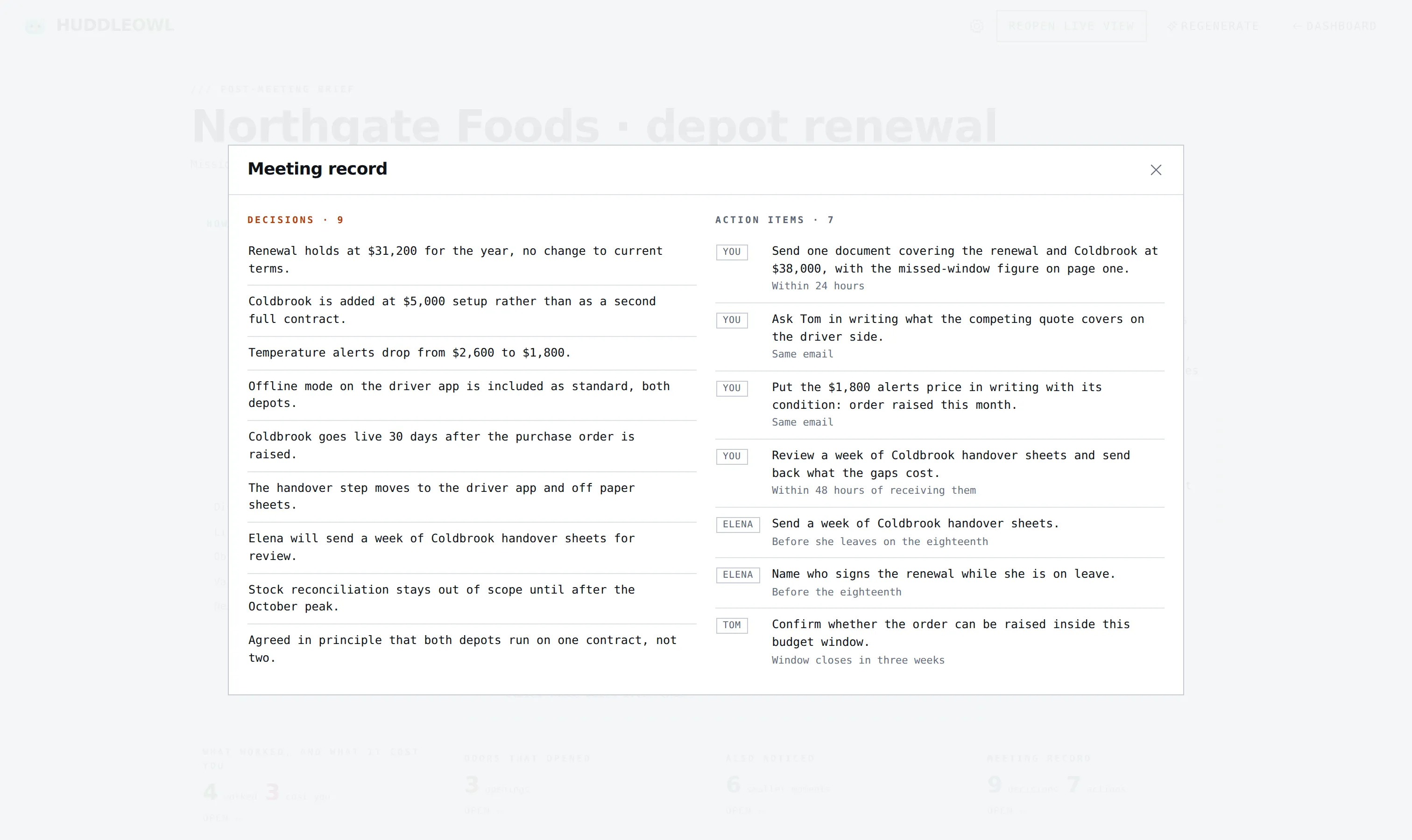
      The meeting record: nine decisions and seven action items with owners, gathered from the whole call
      Nine decisions and seven owned actions out of one call, including the ones settled before anybody had opened a notes app.

      Notes elsewhere

      $170 to $240

      a year, per seat, for the transcript and the summary. Every call goes to somebody else's server to get there.

      Notes here

      $0

      in API costs, on device. No per-minute transcription, no per-token summary, no per-seat markup. And then it scores how you ran the call, which none of them do.

      Four things nothing else does

      The notes are the table stakes.
      These four are why it exists.

      Everything that coaches you live is cloud. Everything that runs on your machine is a notetaker. HuddleOwl is the only one that is both.

      1. 01Coaching nobody else in the call can seeVisible to you, absent from the recording, the Zoom share and the Loom. Clicks pass straight through to whatever is underneath.See it →
      2. 02Every score quotes the line that earned itA cue that cannot point at the sentence it reacts to is discarded before you ever see it. That rule lives in the backend, not in a prompt.See it →
      3. 03It reads the entire call, not the last five minutesMap reduced across the full transcript, and the chunking never splits a speaking turn, so a quote is never half a sentence.See it →
      4. 04The whole thing runs with the wifi offDownload a model once and there is no account, no API key and no network. Same rubric, same quotes, same speed.See it →

      While you are talking

      Coaching that arrives
      in time to use it.

      A note you read tomorrow changes nothing about today. HuddleOwl watches both sides of the call as it happens and puts a card in front of you when there is something to do about it: a question you skipped, an objection you talked past, a buying signal you did not pick up. The signal scores move as the call moves, so you can see it slipping before it has slipped.

      • Both sides, no botNative system audio on macOS, loopback on Windows. Nothing appears in the participant list.
      • Cues that quote the callA cue that cannot point at the line it reacts to is discarded before you see it. That rule lives in the backend, not in a prompt.
      • Your toneDirect, supportive, friendly or blunt. The coaching sounds like something you would actually take.
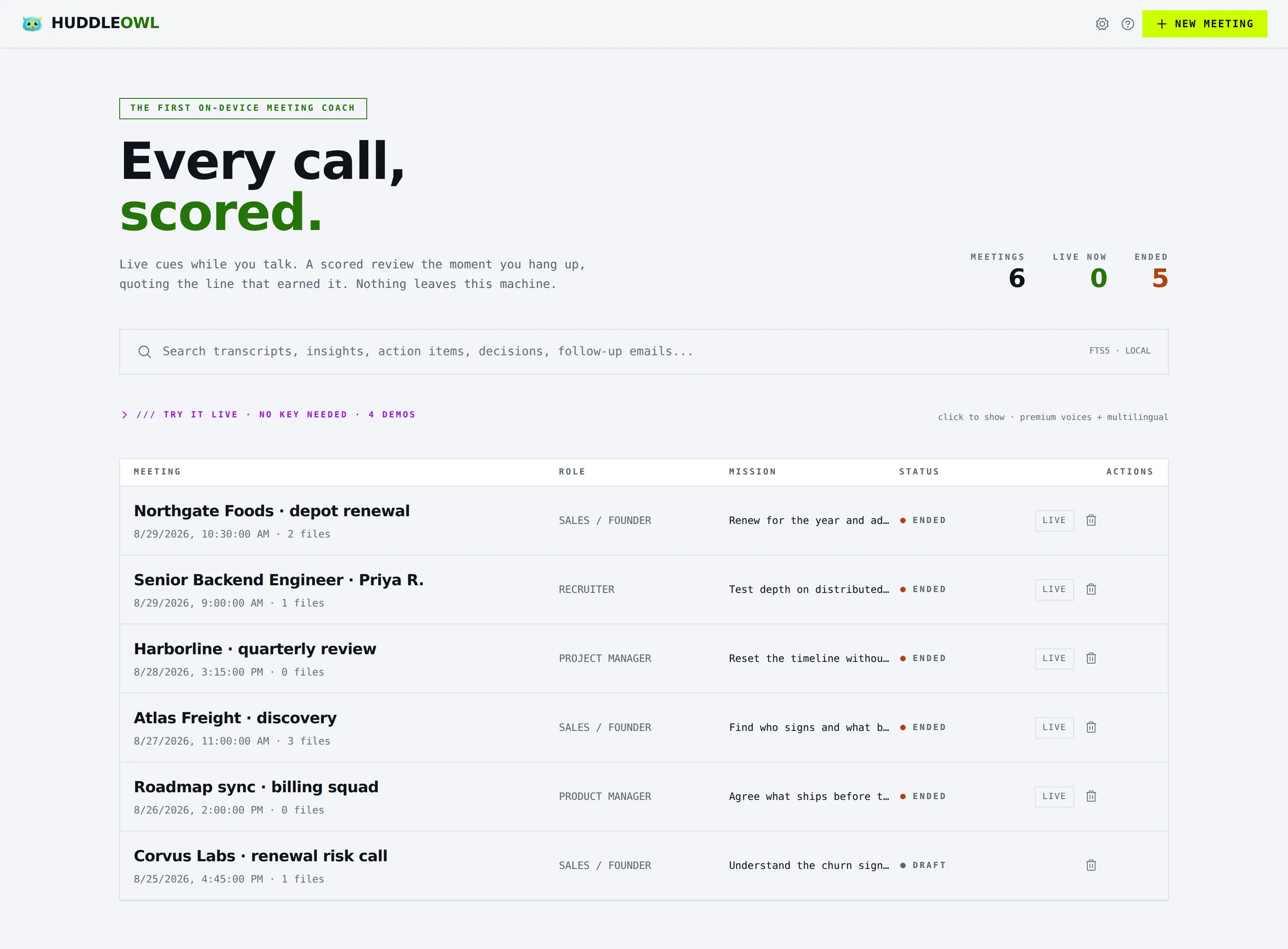
      The meetings list: every call with its role, its mission and its status, above a full-text search box
      Every call you have run, with the mission you set for it. The search box is full text across transcripts, cues, decisions and follow-up emails, and it runs on your own disk.

      About 40 seconds after you hang up

      The review a QA lead would write,
      on every call you take.

      Not a summary. A scored rubric for the role you were playing, a verdict, and the one next step that matters. Sales is graded on discovery depth, listening, objection handling, value framing and next step. PM, recruiter and product each get their own. A dimension the call never tested is left unscored, never quietly given a zero.

      It reads the entire call

      Most tools summarise whatever fits in one context window, which on a 40 minute call means the last few minutes and a confident tone. HuddleOwl map reduces the whole transcript, and the chunking never splits a speaking turn, so a quote is never half a sentence.

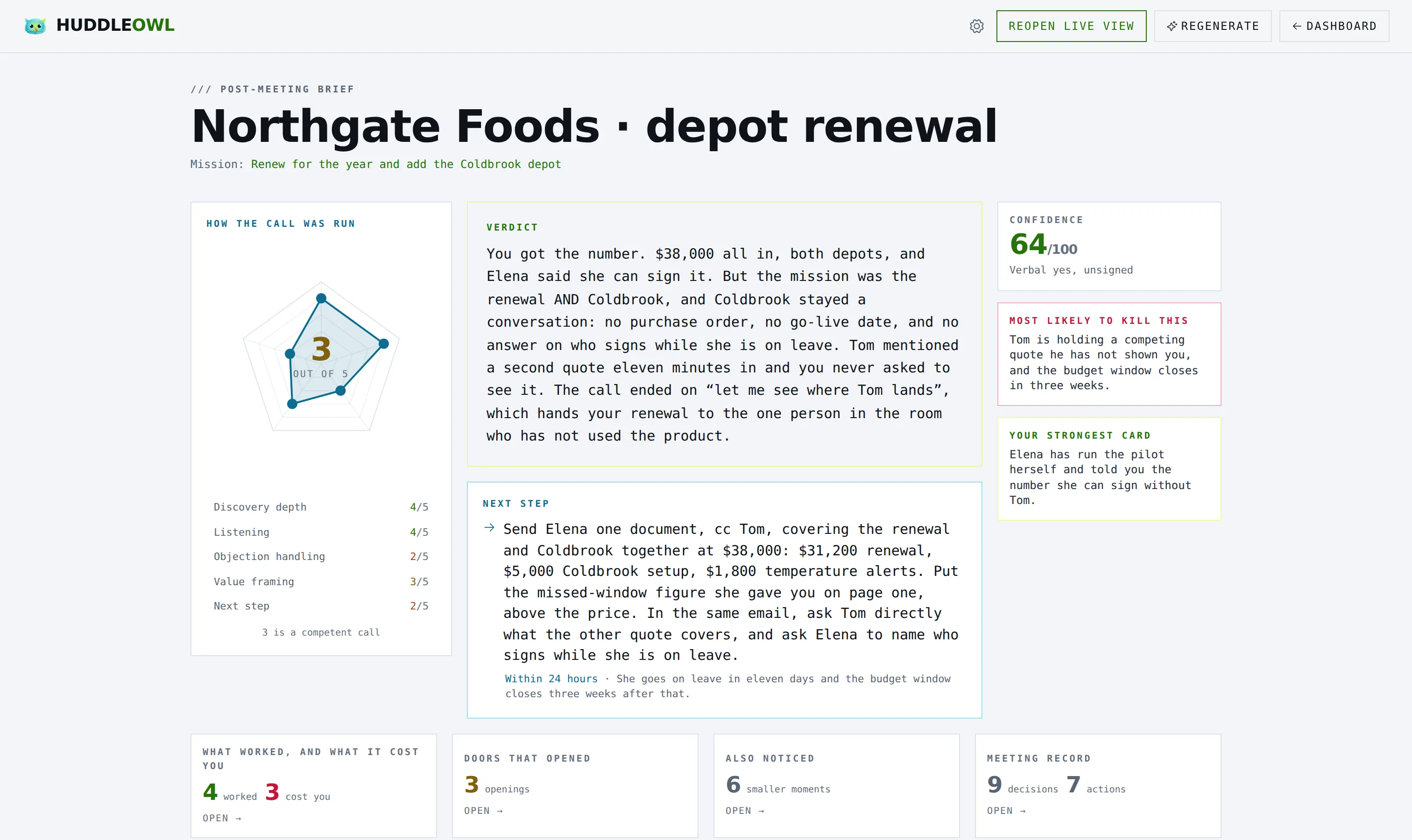
      The post-meeting brief: rubric scores, the verdict, the one next step, and four tiles waiting to be opened
      One screen, no scrolling. The scored rubric, the verdict, and the one next step. Everything else is a tile you open.
      Four tiles, opened and closed. The page underneath never moves.

      The part that makes it trustable

      Every score carries
      the sentence that earned it.

      The scorecard does not tell you to work on discovery. It says 3 out of 5, and here is the line you said. Click any dimension on the web and it opens the reason and the quote. You can disagree with a score, which is the whole point. You cannot disagree with a transcript.

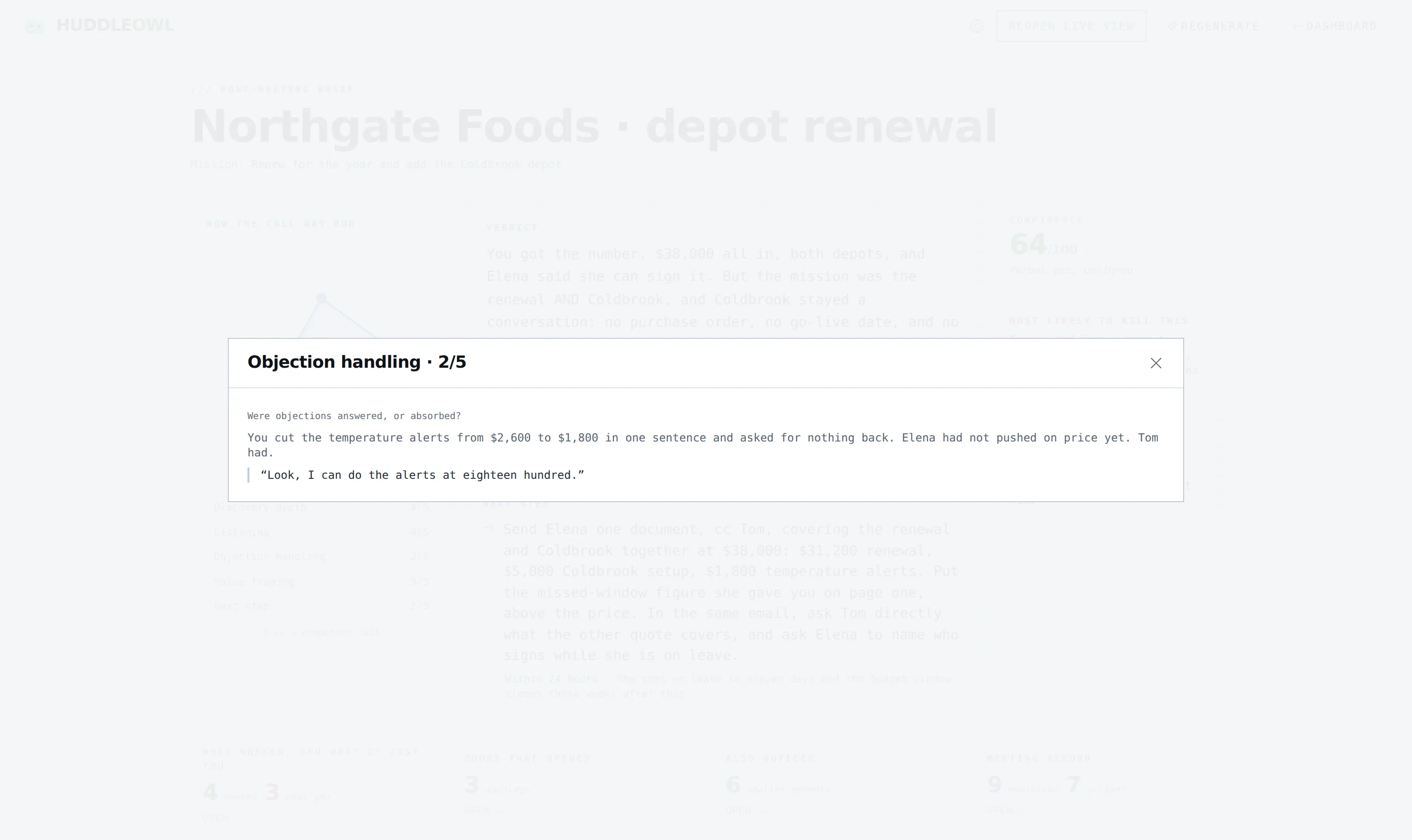
      Objection handling · 2/5

      Were objections answered, or absorbed?

      You cut the temperature alerts from $2,600 to $1,800 in one sentence and asked for nothing back. Elena had not pushed on price yet. Tom had.

      “Look, I can do the alerts at eighteen hundred.”
      Clicking a rubric score opens the reason for it and the exact line from the transcript that earned it
      Every dimension on the web is a button. What it opens is the reason and the line.

      Visible to you, invisible to screen share

      Coaching nobody else
      in the call can see.

      Not dimmed, not minimised. The overlay does not appear in the recording, the Zoom share or the Loom. Clicks pass straight through to whatever is underneath, so you keep working with it sitting on top, and Cmd Shift H brings it back from anywhere if you lose it.

      Move your pointer across the call. The circle is your eyes. Everything outside it is the share.

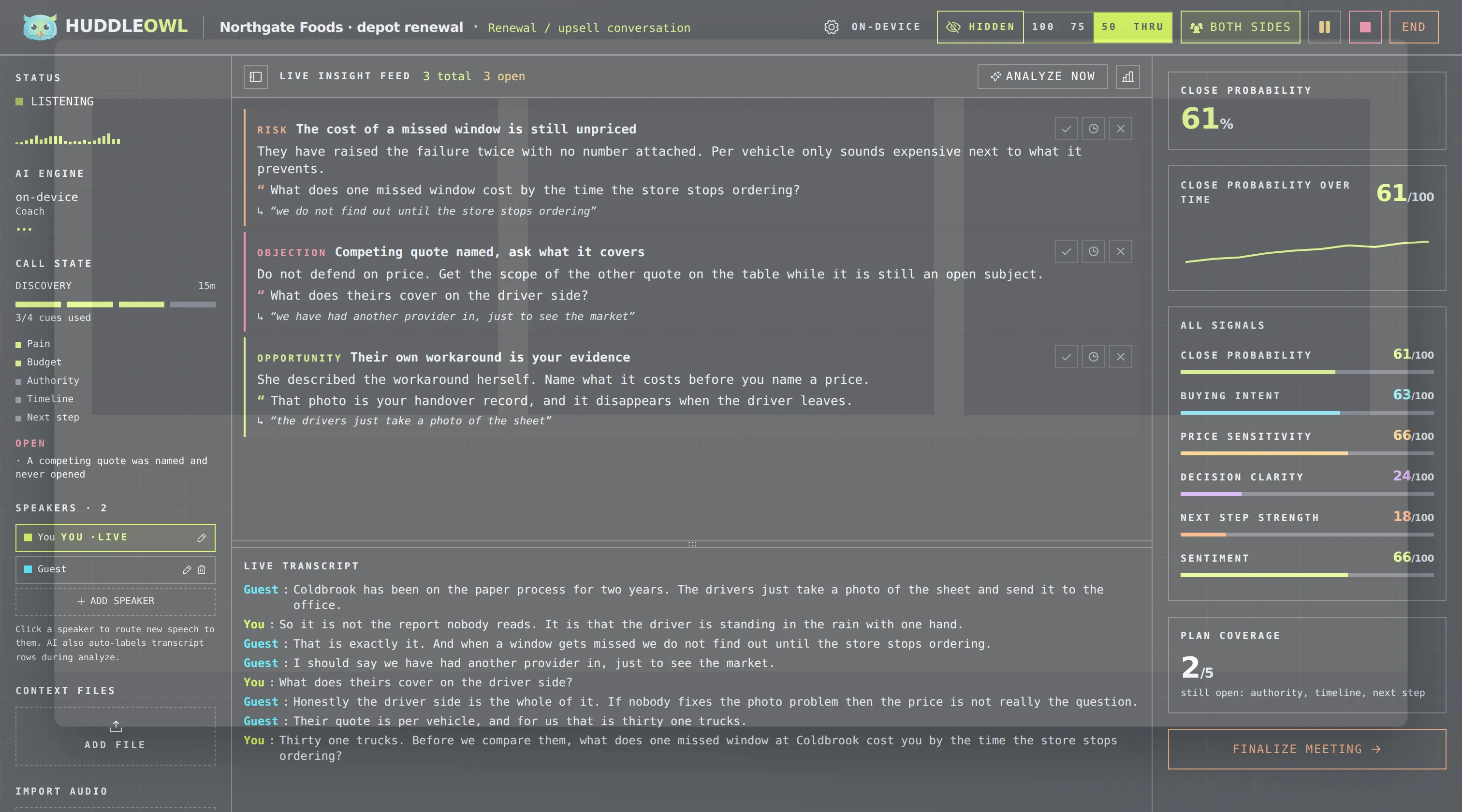
      Switching it on. The window goes see-through, the palette drops to the highest contrast pair it has so the text survives the blend, and clicks start landing on the app underneath.
      Stealth mode held still at 50 percent opacity, the cue feed and scores readable in white on black with the desktop showing through
      Held still. At 50% over an unknown desktop a themed palette composites to a smear, so the whole app drops to white on black. On a window narrow enough to park beside a call, every row still belongs to the call.

      No account. No API key. No network.

      The whole thing runs
      with the wifi off.

      Live transcription, live coaching, the brief, the follow-up email. Download a model once and HuddleOwl needs nothing from anyone. This is not a degraded offline mode: same rubric, same evidence quotes, roughly 40 seconds to a brief.

      network
      online
      transcription
      running · on device
      coaching
      running · on device
      bytes uploaded
      0
      brief after hang up
      ~40s
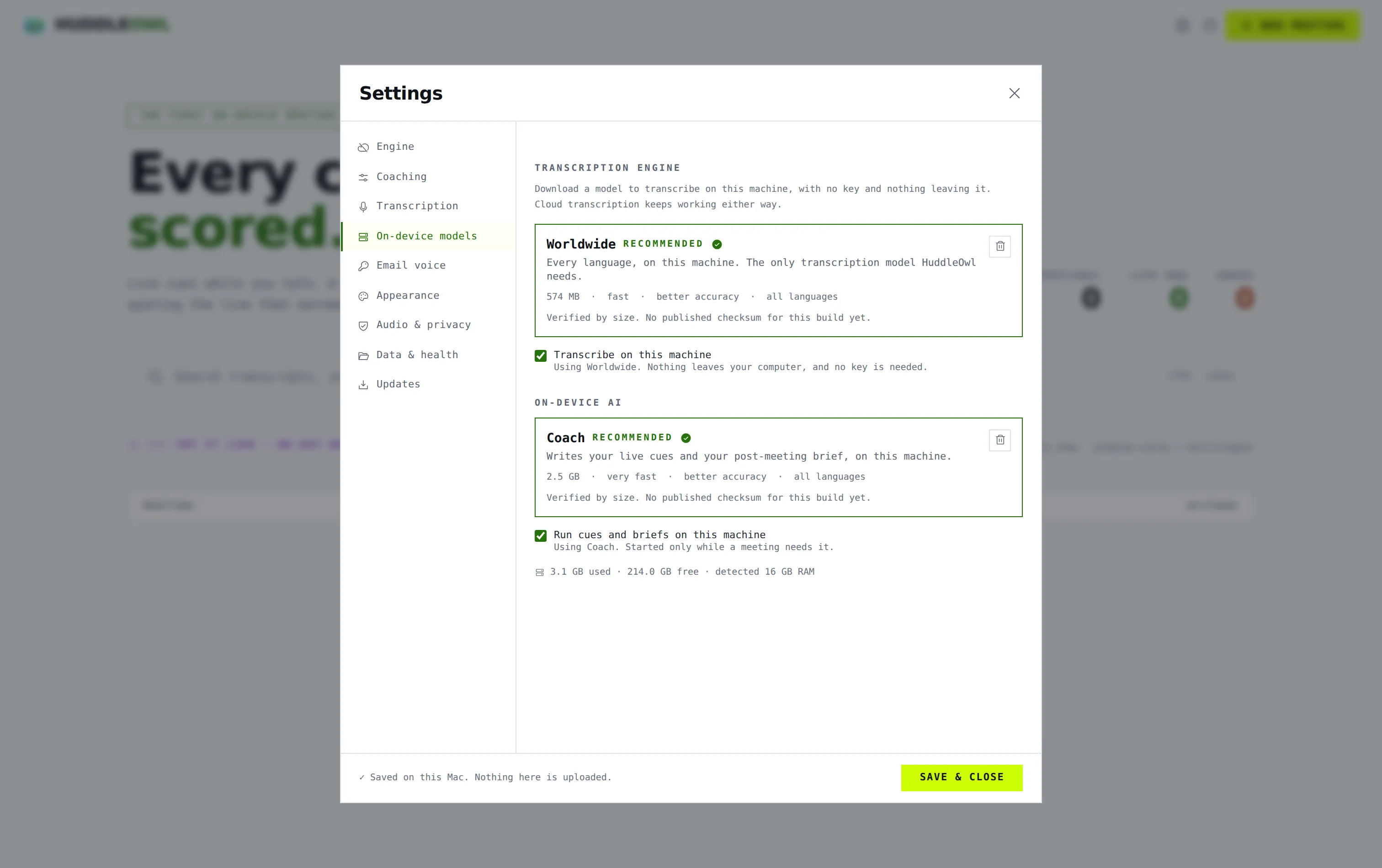
      Settings showing both on-device models installed, with transcription and coaching switched to this machine
      Two models, both downloaded, both engines switched to this machine. From here the app needs nothing from anyone.

      Where this is true today

      The on-device engines ship on macOS. On Windows, HuddleOwl runs against a cloud model of your choosing while the local engines are being built. This page will say so the day that changes, and not before.

      Or bring your own

      Prefer a cloud model anyway? Point HuddleOwl at over 100 providers or at your own endpoint and pay your provider directly. There is no per-seat AI markup from us.

      Where it sits

      The whole category,
      in one table.

      Read the four locked rows and the two coaching rows together. Nobody else has both columns.

      Swipe the table sideways to see the rest →

      ✓ full support · ● partial, or paid tier only · − not available. Compiled from public information, August 2026. Verify anything you plan to rely on.

      What one person pays, per year

      List price for a single seat, before any annual discount.

        On device you pay nothing per call: no per-minute transcription, no per-token coaching. Prefer a cloud model? Bring your own key and pay your provider directly.

        Who it is for

        Built for the person on the call,
        not the person reading about it.

        i.

        Founders selling their own product

        Nobody is listening to your calls. Nobody is going to tell you that you priced in the first four minutes, again.

        ii.

        Solo sellers and consultants

        The coaching a sales manager gives, without the sales manager, and without a recording going to a vendor.

        iii.

        Recruiters and hiring managers

        Scored on role fit, ownership signal, skill confidence and red flags, with the answer that earned each one.

        iv.

        Anyone who cannot let a call leave the room

        Legal, health, HR, anything under an NDA. The wifi can be off and nothing about the coaching changes.

        How it works

        Three steps,
        and none of them is a sign up.

        1. 01

          Download and open

          No account, no email, no key. It opens straight into the app and asks you nothing.

        2. 02

          Set a mission

          One line about what this call needs to achieve. That single line is what you get scored against.

        3. 03

          Take the call

          Cues while you talk, and a scored brief about 40 seconds after you hang up.

        Free forever

        Free, forever, for individuals.
        Teams pay for teams.

        Not a trial and not a freemium ladder. If you use HuddleOwl for your own calls, it is yours. No card, no account, no seat count.

        Apple Silicon · Intel Mac 214 MB · Checksums · Will macOS let me open it?

        Teams, early access

        Free for your whole team,
        while we are still small enough to listen.

        Every person on the team gets the full app at no cost, with no cap on how many of you there are. We are taking on a limited number of teams, because the point of this round is that we actually talk to each one and build the team features around what you tell us. When that stops being possible, it closes.

        • The full app for everyone, free, no seat count
        • A direct line to what gets built next
        • Whatever pricing lands later, early access teams keep their terms

        We read every one of these and reply ourselves. No sequence, no drip, no reselling your address.

        FAQ

        The questions
        people actually ask.

        Does anything join my call?

        No. There is no bot, no extra participant and no calendar connection. HuddleOwl listens to your microphone and your system audio on your own machine, so nobody on the call sees anything different.

        Does my audio leave my machine?

        On a Mac with the on-device models selected, no. Nothing, at all, including when the wifi is off. If you choose a cloud model instead, your transcript goes to the provider you picked, using your key, and never passes through us.

        Is it really free?

        Yes, for individuals, permanently. No card, no trial clock, no feature held back to sell you later. Teams will eventually pay for team features that do not exist yet.

        What about Windows?

        The app runs on Windows 10 and 11 and captures both sides of the call through loopback audio. The on-device engines are macOS only today, so on Windows you currently point HuddleOwl at a cloud model of your choosing. Windows local engines are being worked on, and this page will say so the day they land.

        Which models does it run?

        A Whisper-family transcription model and a local coaching model, both downloaded once from inside the app. Together they are about 3GB and want 8GB of RAM. Or point it at any of 100+ cloud providers, or at your own endpoint.

        Is stealth mode above board?

        It hides the coaching overlay from your screen share so the person you are talking to does not watch you being coached. It does not hide that you are recording, and it does not touch anything on their side. Recording law is yours to follow where you are.

        Where is my data kept?

        In a folder on your disk that you can open from inside the app. Transcripts, cues, briefs and draft emails all live there. Delete the folder and there is nothing left anywhere, because there is no server holding a copy.

        Can I import an old recording?

        Yes. Drop in an audio file you already have and it comes back with the same transcript, the same rubric and the same evidence quotes as a live call.

        Will macOS stop me from opening it?

        No. From 0.4.0 the Mac build is signed with an Apple Developer ID and notarised by Apple. On first launch macOS asks once whether you are sure, the same as it does for any app you download, and it says Apple checked the file and found nothing. Click Open and it never asks again. If you are on 0.3.0 or earlier, macOS called those builds damaged because they were not notarised; xattr -cr /Applications/HuddleOwl.app was the fix, and downloading the current build is the better one.