A bad discovery call is not one where you failed to ask questions. It is one where you asked twenty and left with a list of facts that changed nothing about what you did next.
The difference is not question count. It is whether the answer could have altered your behaviour. A question whose answer you would have ignored is small talk with a clipboard.
The four questions that carry most of it
If you only remember four, these.
“What made you take this call?”
Asked at the start, in exactly these words. Not “what are you looking for”, which invites a rehearsed answer about requirements.
What made them take the call is an event: something broke, somebody complained, a number was missed, a contract is up. The event is the actual reason a deal happens, and it is the thing that will still be true in six weeks when the enthusiasm has worn off.
If there is no event, you are in a research conversation. That is fine, and it is important to know, because a research conversation with a close attached to it goes badly.
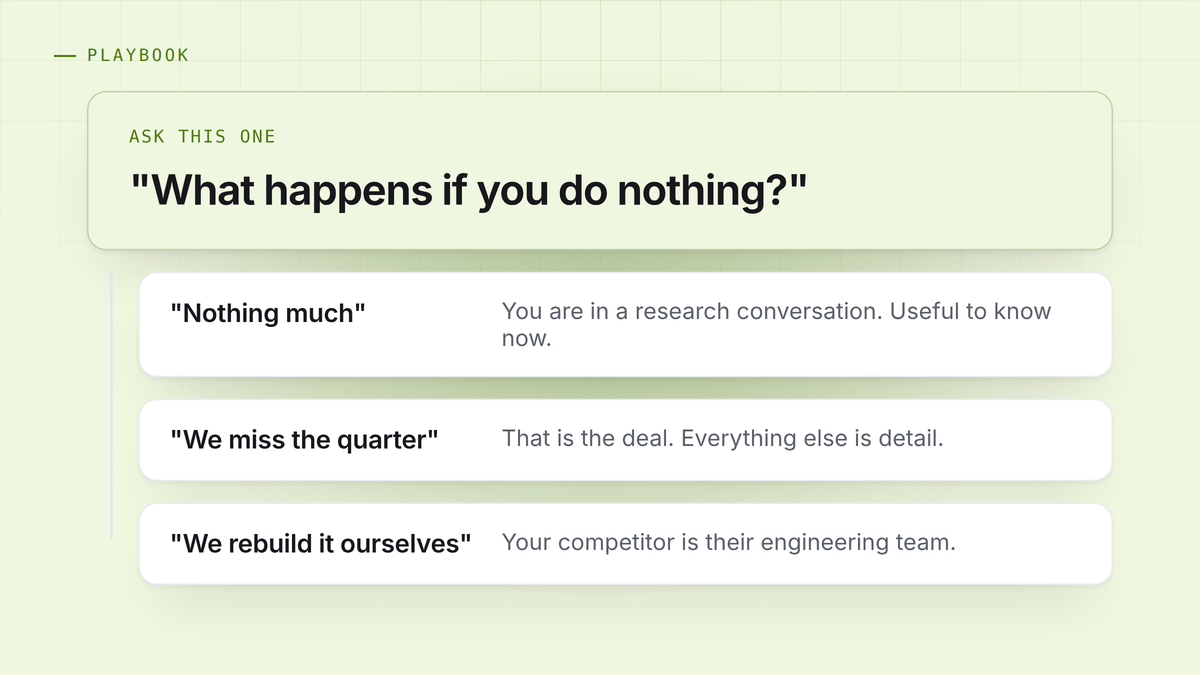
“What happens if you do nothing?”
The most useful question in sales, and the least asked, because the honest answer is often “nothing much” and nobody wants to hear that.
Hear it anyway. The competitor in most deals is not another vendor. It is the status quo, which costs nothing, requires no approval and has never once failed a security review. If the cost of doing nothing is not visible to them, no feature you describe will matter.
“Who else has to be happy with this?”
Not “who is the decision maker”, which produces a job title and often a wrong one. Who has to be happy. That surfaces the security reviewer, the finance approver, the person whose team will actually use it, and the colleague who preferred the other tool.
Then ask a follow-up nobody asks: “what would make them unhappy with it?” You have just been handed the objection you would otherwise meet in three weeks, when you are not in the room.
“Walk me through how it works today”
Concrete, in sequence, with the names of the actual tools and the actual steps.
You get the real workflow instead of an idealised one, you find the workaround they built and are quietly proud of, and you find where the pain actually is, which is usually two steps away from where they said it was.
Eight more worth having
- “When did this become a priority?” Recent means budget. A two year old irritation means no urgency, whatever they say.
- “What have you already tried?” Tells you what not to pitch, and how sophisticated they are.
- “What would have to be true for this to be an easy yes?” They will tell you the criteria. Sometimes they discover them while answering.
- “How would you measure whether it worked?” No answer means no success criteria, which means an ambiguous renewal.
- “What is your timeline, and what is driving it?” The second half is the question. A date with nothing behind it is a wish.
- “Has anything like this stalled here before?” Procurement history predicts procurement future better than enthusiasm does.
- “What is the smallest version of this that would be worth doing?” Turns a stalled large deal into a live small one.
- “What am I not asking that I should be?” Ask it at the end. It works far more often than it has any right to.
The four habits that ruin it
Knowing the questions is easy. The failure is in the delivery, and it is the same four every time.
Stacking. Two questions in one breath. They answer the second, the first is lost, and the first was the good one. Ask one thing and stop.
Answering your own question. “What is the main problem, is it the reporting side of things?” You have just handed them an answer, and people take the offered answer because it is easier than the true one.
Moving on from a good answer. Somebody says “it has been a nightmare since we changed systems” and the next question is about headcount. That sentence had at least three follow-ups in it. The best discovery is mostly follow-ups.
Talking through the pause. Two seconds of silence feels like ten. Sit in it. The sentence that comes after somebody’s pause is regularly the most valuable one in the call.
Doing this while also running the call
All of that is obvious written down and hard at 3pm on a Thursday, because you are also tracking the agenda, the time, the demo and the person who joined late.
That gap is the whole reason live coaching exists. HuddleOwl watches the transcript while the call is happening and puts a card on screen when it catches one of these: a question stacked on another, a stated problem that never got a follow-up, the close approaching with no next step agreed. Each card quotes the line from the transcript that triggered it, so you can tell in one glance whether it is right, and it cannot appear without that quote.
Afterwards it scores the call against the rubric for the meeting type and shows you which of these you actually did, with the evidence. It is the part that is hard to self-assess, because the calls you remember badly are not the ones that went badly.
There is a version tuned for sales calls and one for recruiting, and the comparison with the notetakers that only write it up afterwards sets out the difference plainly.
HuddleOwl coaches you during the call and scores it afterwards, from your own machine, with nothing joining the meeting. Free.


