One call, thirty-three pieces of advice
The first version of the live coach ran on a timer. Every twelve seconds it sent the recent transcript to a model and asked what the user should do.
It worked, in the sense that cards appeared. One forty-minute call produced thirty-three of them. Nobody read past the fourth.
The failure is not that the model was bad. It is that the question was unanswerable in the wrong direction. Ask a capable model what should this person do differently and it will never reply “nothing, they are doing fine”. There is always a slightly better question that could have been asked. So you get advice at exactly the rate you ask for it, and its median usefulness falls to zero while its volume stays constant.
Advice you have to filter is worse than no advice, because now you are doing two jobs during a call instead of one.
The rule
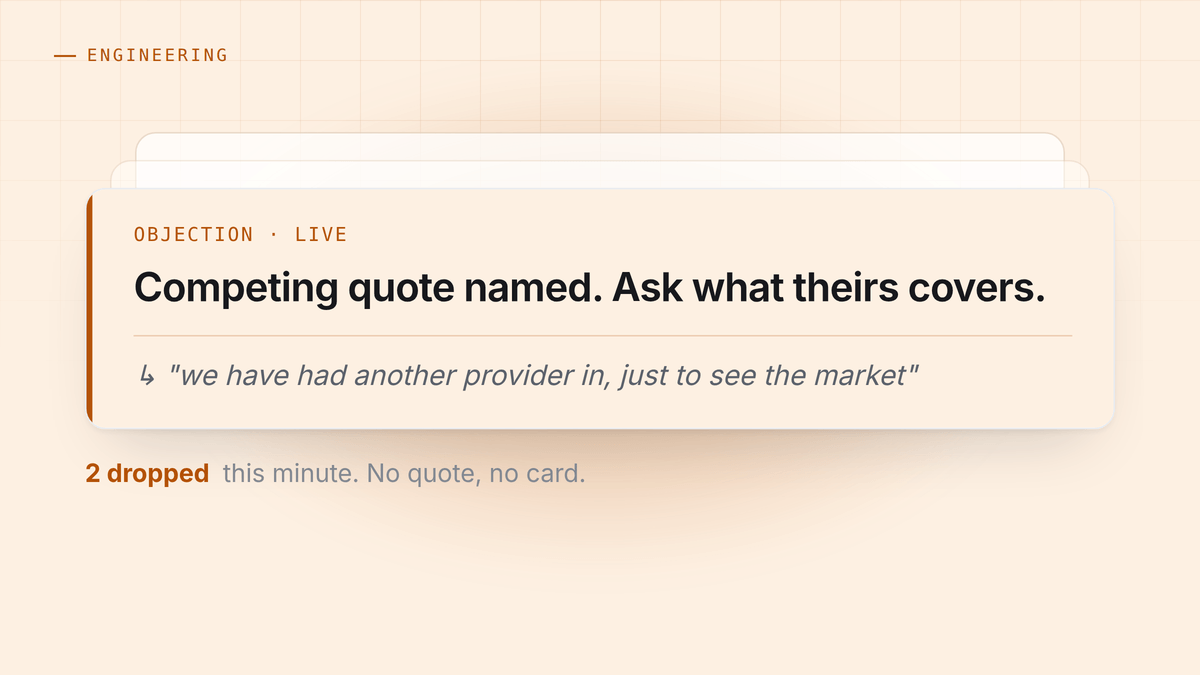
A cue that cannot point at the line in the transcript it is reacting to is discarded before it reaches the screen.
Not discouraged in a prompt. Discarded, in the backend, by code that checks whether the
evidence field matches something actually said. A cue without a quote never renders.
That single constraint does most of the work, because of what it eliminates. Generic advice cannot survive it. “Ask more open questions” has no line behind it. “You moved to price 40 seconds after they said budget” does, and the line is right there under the card.
It also changes what the cue is for. A card with a quote is not an instruction, it is a receipt. You can look at the line, decide the coach has misread the room, and dismiss it in half a second. That judgement is only available to you because the evidence came with the claim.
Three more gates, in the order they run
The quote rule alone is not enough, because a model can find something quotable every time. Three other things had to be true.
A budget. Four cues a call by default. It is spent when it is spent. A budget forces the coach to hold fire on the mildly interesting thing in case the genuinely important thing arrives at minute thirty, which is the actual skill a good sales manager has when they sit in on a call.
Spacing. Two cards fifteen seconds apart are one card, in terms of how much a person who is talking can absorb.
An event, not a timer. The poll asks the server has anything happened, and the answer is usually no, which costs a cheap string scan and no model call at all. The model is only asked when the transcript did something worth asking about: an objection pattern, a price mention, a long stretch of one person talking.
That last one is where the cost went too. The thirty-three-cue version ran a model call every twelve seconds for the whole meeting. The current one runs a handful, which is why the whole thing fits on a laptop.
What it looks like when it is right
Four cards in forty minutes. Each one names a specific thing, quotes the line that caused it, and can be ticked off, deferred or dismissed in one click.
The strongest signal that the rule works is not that the cues are good. It is that the screen is quiet for long stretches, and the quiet is a decision the coach made rather than something being broken. The app says so in the sidebar: what the coach has established, how much of its budget is left, and what it is still waiting to hear.
The same rule, after the call
The post-meeting brief inherits it. Every dimension in the scorecard is scored from zero to five, and every score carries the reason and the exact sentence that earned it.
That is what makes a score arguable, and being arguable is the point. You can look at a 2 out of 5 on objection handling, read the line, and conclude the coach was wrong about it. You cannot do that with a number on its own, and a number on its own therefore teaches nobody anything.
A dimension the call never tested is left unscored rather than quietly given a zero, for the same reason. A zero you did not earn is not feedback, it is noise with a decimal point.


