There are two ways to run an interview badly, and most interviewers alternate between them.
Type everything, and you conduct the conversation through a laptop lid. The candidate is talking to the top of your head, the rapport never arrives, and the answers get shorter because nobody performs well for somebody who is not looking at them.
Type nothing, and four hours later you write “strong communicator, good culture fit”, which is not a note. It is a feeling with a job title attached, and it is exactly the kind of note that falls apart in a debrief and cannot be defended if a hiring decision is ever challenged.
What a defensible note actually contains
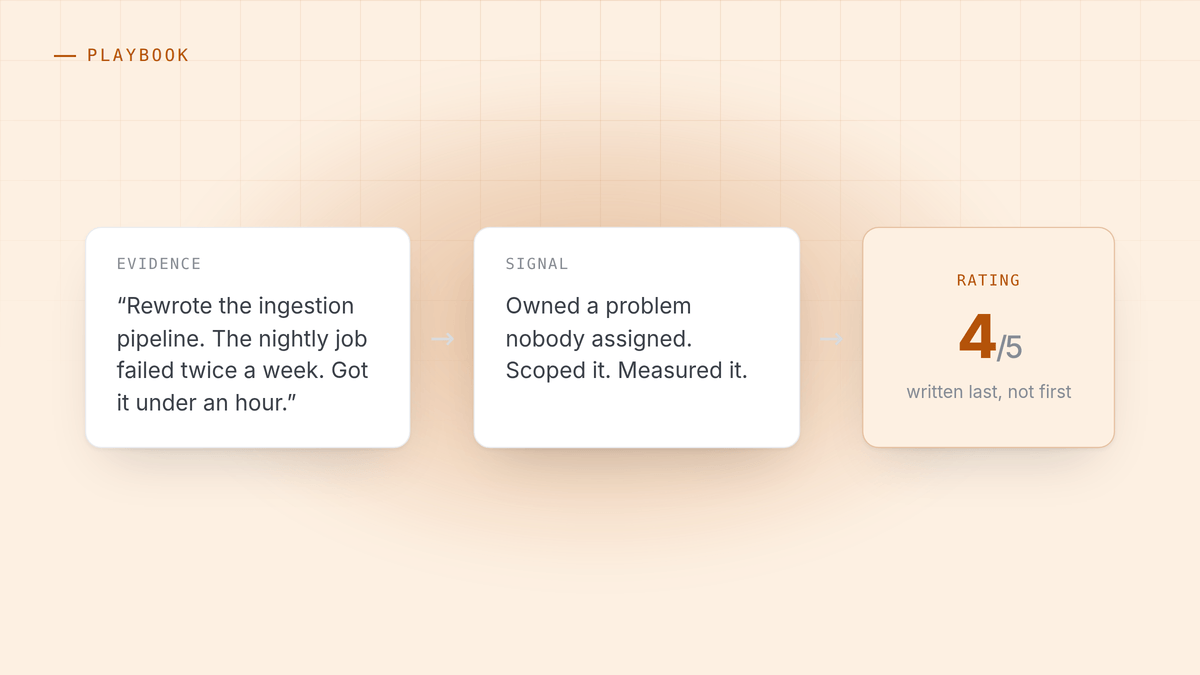
A useful interview note has three parts, and the first is the one people skip.
The evidence. What the candidate said, close to how they said it. “Rewrote the ingestion pipeline because the nightly job was failing about twice a week, cut it to under an hour.” Specific, checkable, theirs.
The signal. What that is evidence of. Ownership. Scoping. Communication under pressure.
The rating. Only after the first two exist.
Written in that order, a note survives a debrief. Written in reverse, which is what happens when you rate first and hunt for support afterwards, it is confirmation bias with a form around it.
This is the same discipline as structured interviewing generally: agree the criteria before the interview, collect evidence against those criteria during it, and score after. The research support for structure over intuition in hiring is about as strong as it gets in this field, and it is in the references below.
The mechanics of not looking down
Practical things that work, in rough order of how much they help.
Have the criteria on paper, not on screen. Four or five, written down before you start. Glancing at a sheet reads as prepared. Glancing at a screen reads as distracted.
Write nouns, not sentences. “nightly job, 2x/wk, under 1hr” is enough to reconstruct the answer in an hour and takes two seconds. A full sentence takes fifteen and costs you the follow-up.
Leave the two second gap. After they finish, wait. This is where the qualification they were not going to mention arrives. It also gives you a natural place to write, at the one moment nobody is talking.
Say what you are doing, once. “I am going to make some notes so I can represent you properly to the team.” Now the typing is on their side rather than a distraction. If you are recording, this is the same sentence, extended by four words, and the reasons that is the right habit are in is it legal to record a meeting.
Write the rating in the last five minutes, in the room. Not later. Not after the next one. The distinctness of two candidates collapses within a couple of hours and what survives is who you liked.
Where recording changes the job
If the conversation is captured, the note-taking problem inverts. You are no longer trying to record what happened. You are trying to notice what is happening.
That is a better use of a human. Only a person in the room can catch that the candidate lit up talking about mentoring and went flat talking about the architecture they supposedly led, and no transcript will tell you that.
It also removes the worst part of the debrief, which is two people remembering the same answer differently and neither of them able to produce it.
The cost is that recording an interview is a bigger deal than recording a sales call. Candidates are in a weaker position than clients, so consent has to be genuinely voluntary and the answer no has to be survivable. Some jurisdictions and some employers have specific rules for recording candidates. Ask, ask before the interview rather than in it, and be prepared to run it unrecorded. A candidate who feels they could not reasonably refuse has not consented to anything.
The structure worth stealing
Five boxes on one sheet, filled in during the interview:
- Role scope. What they actually owned, with the size of it. Team, budget, systems, scale.
- A hard thing. One difficult situation, in detail, including what they would do differently. The follow-ups matter more than the story.
- Craft. One depth probe in their actual discipline. Not trivia, and not a puzzle.
- How they work with people. Asked as a specific incident, never as “are you a team player”.
- Their questions. What a candidate asks tells you what they care about and how carefully they have thought about the job. This is data, not a formality.
Five boxes, each with evidence and then a signal. Every interviewer on the panel fills in the same five, which is what makes the debrief a comparison rather than a negotiation between confidence levels.
Doing the noticing while the notes take themselves
This is the specific thing HuddleOwl is built for on an interview: the transcript and the attribution happen on their own, so your attention stays in the room, and a card appears during the call when something is worth catching. A claim that never got a follow-up. A criterion you have not covered with ten minutes left. A stretch of the interview where you have been talking more than the candidate.
Afterwards it produces the evidence-first version of the note: what was said, what it supports, and a score against the rubric for the meeting type, with the quotes attached. The audio never leaves the machine, which for interviews is not a preference so much as the entire condition of doing it at all. There is more on that architecture in why nothing joins your meeting, and a page on the recruiting version.
HuddleOwl runs on your own machine, nothing joins the call, and it is free. For teams hiring at volume there is a page on recruiting.
References
- Schmidt and Hunter, The validity and utility of selection methods in personnel psychology, on structured interviews against unstructured ones.
- US EEOC guidance on employee selection procedures.
- UK ICO employment practices guidance, on candidate data.


