Watch a recording of your own call and skip to five minutes from the end. Most people find the same thing: energy dropping, a summary nobody needed, a vague promise to follow up, and a goodbye.
The middle of a meeting is where the information is. The end is where the outcome is decided, and it is the part almost nobody prepares.
Why the end is where it goes wrong
Three things happen at once in the last five minutes.
You relax. The hard part feels finished. Attention drops exactly when precision matters most.
They relax too, which is why the most honest sentence of the meeting is often the one said while people are closing laptops. The real objection arrives after the official conversation has ended, and it arrives once.
The clock forces a decision. You either leave with a specific next step or you leave with “let’s circle back”, and those produce very different outcomes with the same amount of goodwill in the room.
A sequence that works
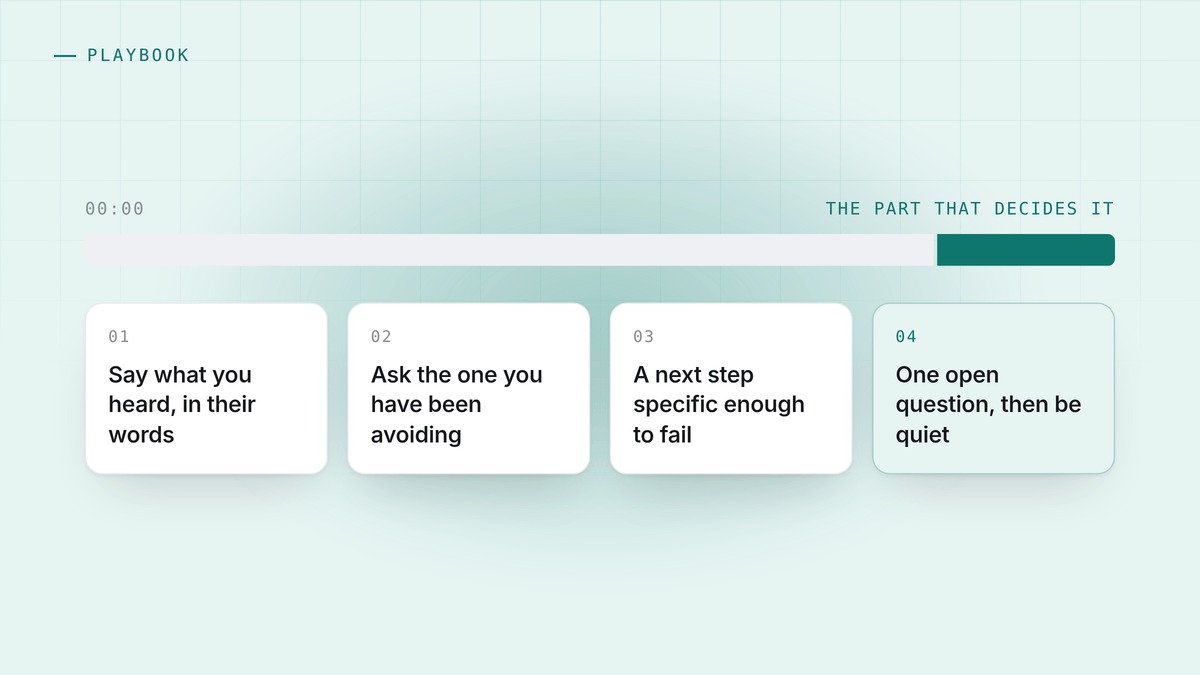
Five minutes, four moves, in this order. The order matters more than the wording.
1. Say what you heard, in their words
Not a summary of the meeting. A summary of their problem, using the words they used.
“So the thing that is actually costing you is the two weeks of back and forth before anything gets approved, not the approval itself.”
This does two jobs. It proves you were listening, which is worth more than anything you said. And it gives them a cheap chance to correct you, which they will take, and the correction is usually the most valuable sentence in the whole call.
If you cannot do this without notes, that is a signal about the first forty minutes.
2. Ask the question you have been avoiding
Everyone has one. The budget question. The “who else is deciding this” question. The “is there a reason this would not go ahead” question.
People save it for the end and then run out of time, which is not an accident. Running out of time is how you avoid it while feeling like you tried.
Ask it at minute five, not minute one. There is enough rapport by then to survive it and enough time to hear the answer.
3. Make the next step specific enough to fail
“I will follow up” cannot fail, which is why it is comfortable, and why it is useless.
A next step needs three things: who, what, and when. “I will send the pricing for the two options we discussed by Thursday, and you will get me the name of whoever signs off on security.” Now both of you can tell on Friday whether it happened.
4. Ask one open question, then be quiet
“Is there anything we have not talked about that we should have?”
Then stop. Say nothing. The silence is uncomfortable for about four seconds and then it gets filled, and what fills it is frequently the thing that decides the outcome. The concern they did not want to raise formally. The other vendor. The reorganisation nobody has announced.
This one question changes more calls than any other, and the only skill it requires is tolerating a pause.
What this looks like when it is going wrong
Some things at the end of a call are worth noticing in the moment.
You are talking more than they are. In the last five minutes, that is nearly always bad. A close is a confirmation, not a pitch.
You have said “just” or “quickly” three times. Minimising language at the end signals you know you are over time and are compressing rather than choosing what to drop.
Nobody has said a date. A meeting without a date attached to it did not end, it stopped.
You are answering a question they did not ask. A sign you are filling silence rather than using it.
Watching for these while also running the conversation is the actual difficulty. This is the specific thing HuddleOwl watches for: a card appears while you are still talking, quoting the line from the transcript that triggered it, and one of the built-in checks is whether a concrete next step was agreed before the call ended. Every cue has to quote the call, which is a rule enforced in the backend rather than in a prompt.
The five minutes after the call
Not part of the meeting, but part of the outcome.
Write the follow-up now. Not this afternoon. The specific detail that makes a follow-up worth reading, the phrase they used, the constraint they mentioned in passing, is gone in about twenty minutes. What survives to the afternoon is the generic version, which reads like every other follow-up they got this week.
Three things belong in it: what they said their problem was, in their words; what you agreed to do, with the date; and what you need from them, with the date. Under 150 words. Anything longer is for you rather than for them.
If you have a transcript, this is a two minute job rather than a twenty minute one, because the exact phrasing is right there instead of in your memory of it.
HuddleOwl sits beside the call, tells you when the close is drifting while there is still time to fix it, and drafts the follow-up from what was actually said. Free, and nothing joins the meeting. Sales teams can see the version tuned for them.


