
Playbook5 min
The discovery questions that actually change the deal
Most discovery calls collect facts nobody uses. Twelve questions that change what happens next, and the four habits that quietly ruin the call.
Product managers and researchers
A user interview goes wrong quietly. You ask the user to agree with you, they oblige, and you leave with a validated belief you walked in holding. That is visible in the transcript and almost never visible in the room.
Apple Silicon · free forever for individuals · no account · v0.5.0
User interviews, coached while you run them
Cues arrive during the call, and a cue that cannot point at the line in the transcript it is reacting to is discarded in the backend before it reaches you. These are the shape of the ones that survive.
That was a leading question. Ask what they did last time instead of whether they would use it
They asked for a dashboard. Nothing yet on what they do with the number once they have it
You have confirmed the belief you arrived with twice and tested it zero times
A workaround was described in passing and never priced
Live signals
The scorecard afterwards
A dimension the call never tested is left unscored rather than quietly given a zero, because a zero you did not earn teaches you nothing.
About 40 seconds after you hang up
A scored rubric, a verdict and the one next step that matters. Everything else is a tile you open, and the page underneath never moves.
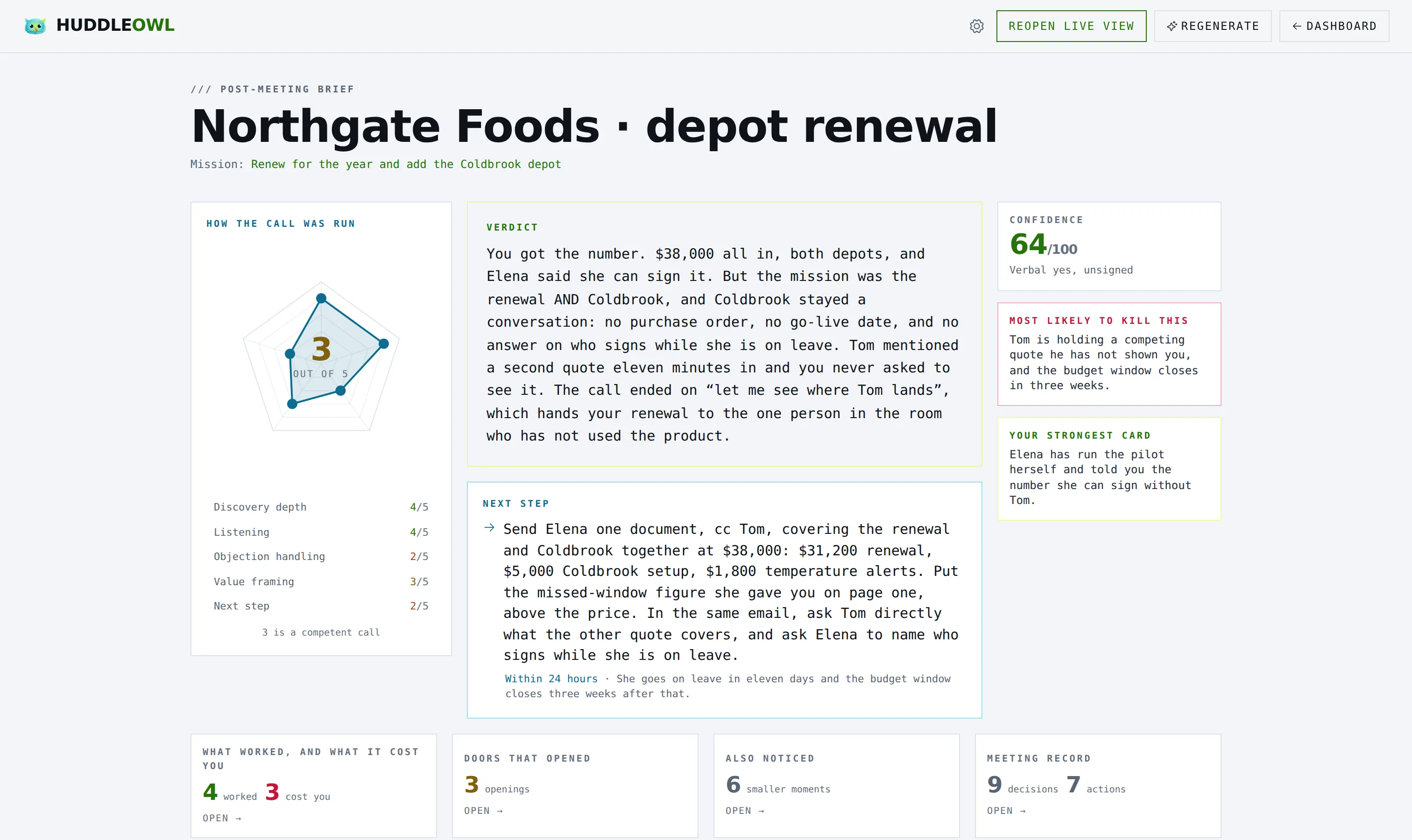
Name what you are trying to find out and it will notice when you stop trying to find it out.
You pick one of these when you set the meeting up. It becomes the thing the call is measured against, and the reason a cue can say you have not got there yet:
What it is not
It does not synthesise across interviews or build an insight repository. It works one conversation at a time.
No account, no card, no bot in your next call. Download it and run one meeting through it.
Apple Silicon · free forever for individuals · no account · v0.5.0

