The default follow-up email is a summary of the meeting. Both people were at the meeting. Nobody needs the summary, which is why nobody replies to it.
A follow-up that works is not a record. It is the next move, written down.
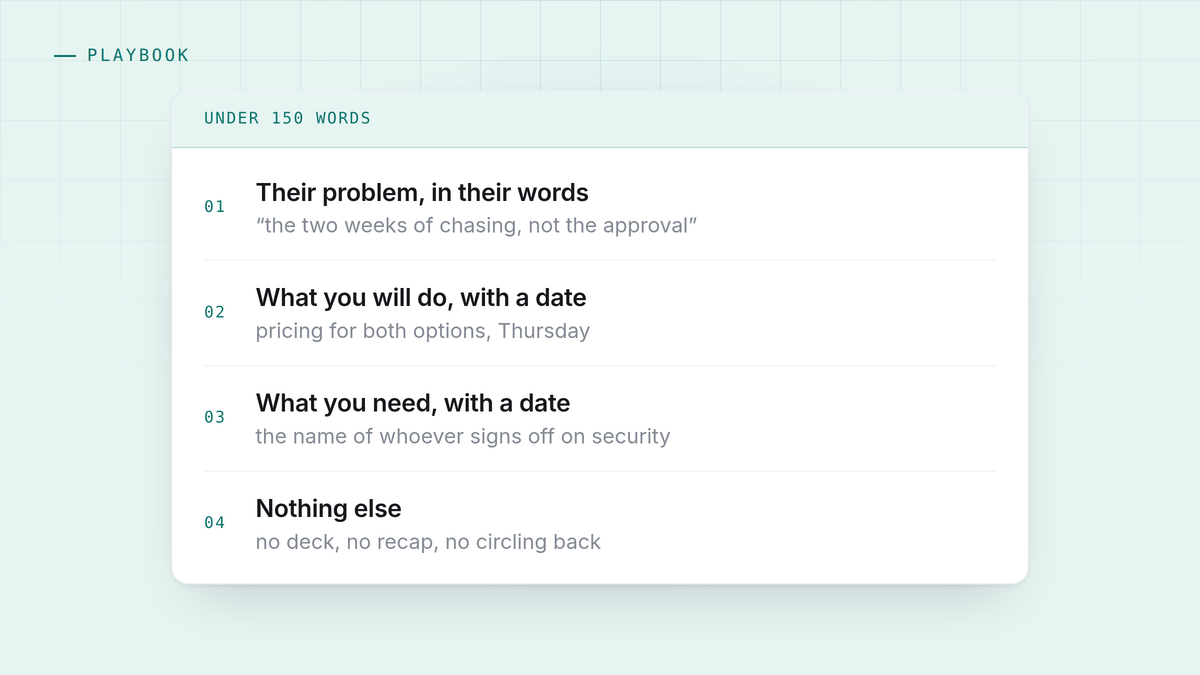
The four parts
In this order, and the order matters.
1. Their problem, in their words
Not yours. Theirs, using the phrase they used.
You said the two weeks of back and forth before anything gets approved is what actually costs you, more than the approval itself.
This is the whole email’s credibility. It proves you listened, it gives them a cheap chance to correct you, and the correction is often the most useful reply you will get. Generic follow-ups fail here first: they summarise the meeting instead of the person.
2. What you are going to do, with a date
I will send pricing for the two options we discussed by Thursday.
Specific enough to fail. “I will follow up” cannot fail, which is exactly why it does nothing.
3. What you need from them, with a date
Could you send me the name of whoever signs off on security, this week?
One thing. Not four. A list of four requests reliably gets zero, because it becomes a task rather than a reply.
4. Nothing else
No recap of your features. No attached deck they did not ask for. No “as discussed, here are the many ways we can help”.
Why under 150 words
Because the reply you want takes ten seconds to write, and every extra paragraph makes the email feel like something to deal with later rather than now.
A long follow-up is almost always written for the sender: it is proof of effort, or an attempt to re-pitch in writing what did not land in person. The recipient experiences it as homework.
If you genuinely have a lot to send, send it as a separate email with its own subject line. Do not staple it to the one asking for a reply.
Send it within the hour
This matters more than the wording.
The specific detail that makes a follow-up worth reading, the phrase they used, the constraint they mentioned in passing, the name of the system they are stuck with, decays in about twenty minutes. What survives to the afternoon is the generic version, which reads like every other follow-up they got this week.
If you have a transcript, this becomes a two minute job rather than a twenty minute one, because the exact phrasing is in front of you instead of in your memory of it. That is one of the two things a recording is genuinely good for, the other being that you stop taking notes during the conversation at all.
Three to steal
After a discovery call
Thanks for the time. What stuck with me is that the cost is the two weeks of chasing before approval, not the approval itself.
I will send pricing for the two options by Thursday, scoped to that rather than to the whole platform.
Could you tell me who signs off on security? I would rather find out what they need now than in three weeks.
After a meeting that did not go well
I think I spent too long on the demo and not enough on the migration question you raised, which was the real one.
Give me twenty minutes next week and I will come with an actual answer on it. Does Tuesday or Wednesday work better?
Naming the failure yourself is disarming and it is rare. It gets replies that a cheerful recap does not.
After an internal meeting
Decisions: we ship the current version on the 14th, the reporting work moves to Q4.
Open: nobody owns the data migration. Priya, can you take it or should it come to me?
Next check: Thursday standup.
Three lines, one named person, one date.
What ruins it
- “Just circling back.” It says nothing, and it says you have nothing to add.
- Rewriting the pitch. If it did not land in person, it will not land in a paragraph.
- Asking for four things. Ask for one.
- A summary of what they already know, with the actual ask buried in the last line.
- Waiting until tomorrow. The version you write tomorrow is worse.
Doing it from what was actually said
HuddleOwl drafts this from the transcript rather than from your memory: their problem in their words, what you agreed to, and what you asked for, with the tone set to how you actually write. It is a draft, not a send, and the point is that it starts from what happened on the call.
The other half of the same problem, making sure there was something to follow up on at all, is in the last five minutes are the call.
HuddleOwl records on your own machine, coaches you during the call, and drafts the follow-up from what was said. Free, and nothing joins the meeting. There is a version tuned for sales.


