Most minutes are a transcript with the interesting parts removed. They record who spoke and roughly what about, in order, at length, and the one thing a reader wants, what was decided and who is doing what, is somewhere in paragraph four.
The fix is structural, not stylistic. Minutes should be organised by outcome, not by chronology.
Three things, in this order
Everything a reader needs is one of three things. Put them at the top, in this order, and the rest is optional.
Decisions
What was actually settled. Written so that somebody who was not there could not misread it.
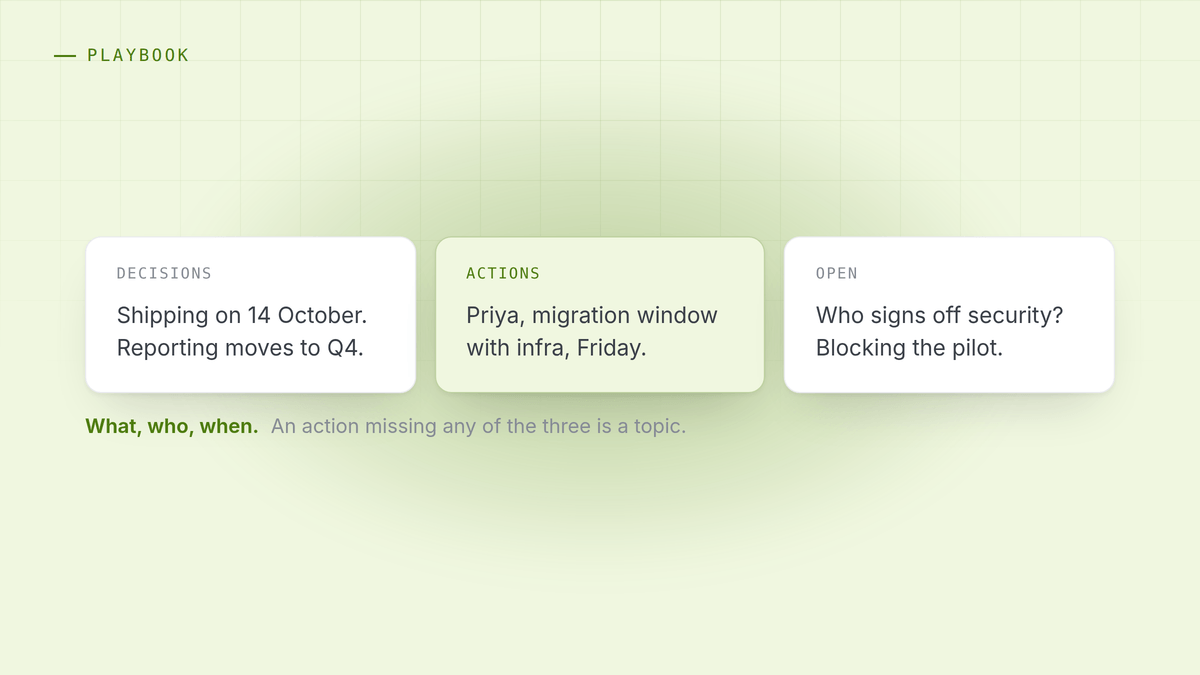
Shipping the current version on 14 October. The reporting work moves to Q4.
Not “we discussed the timeline and agreed it was tight”. That is a description of a conversation, not a decision.
If nothing was decided, write that. “No decision on the migration owner.” A meeting that decided nothing should say so in its own record, because that is how a pattern of meetings that decide nothing becomes visible.
Actions
Three fields, all mandatory: what, who, when.
Priya to confirm the migration window with infrastructure, by Friday.
An action without a name is not an action. An action without a date is not an action. If you cannot fill in all three, the item is not an action, it is a topic, and it belongs in the third section.
Use the person’s name, not the team’s. “Marketing to review” is a task assigned to nobody.
Open questions
What is still unresolved, and what would resolve it.
Who signs off on the security review? Blocking the pilot date.
This is the section most minutes omit, and it is the one that stops the same conversation happening again next month with everyone slightly surprised.
Then the rest, and less of it
Below those three, a short section of context: what was raised that a future reader might need. Keep it to what changes a decision, not what was said.
The test for every line: would somebody act differently if they knew this? If not, cut it.
Nobody has ever complained that minutes were too short.
Practical mechanics
Write in the meeting, not after it. Minutes written from memory an hour later are uniformly worse, and it is the actions that get vague first.
Read the actions out loud before the meeting ends. Two minutes, and it catches the thing that ruins minutes more than anything else: an action assigned to somebody who does not agree they own it. If it is read out and they do not object, it is real.
Circulate the same day. Minutes arriving three days later are a historical document. Arriving within the hour, they are still a to-do list.
Use the same three headings every time. Predictable structure means people can skim directly to the part they need. Variety in a document like this is a cost, not a feature.
Never editorialise. Minutes record what happened. “Discussion became unproductive” is a judgement, and it will be quoted back at you.
The formal case
For a board, a committee, a works council or anything with a legal or regulatory function, the requirements are stricter and set by whoever governs the body: attendance, apologies, conflicts declared, votes and their counts, formal approval of the previous minutes. That is a different document and the rules come from your governing instrument, not from an article.
The structure above is for the other ninety-five percent of meetings, where nobody has told you what the minutes must contain and the only real requirement is that they are useful.
Taking minutes while also being in the meeting
The genuine difficulty is that the person best placed to take good minutes is usually the person who most needs to be participating. Doing both means doing both badly.
This is where a recording changes the job rather than just the effort. If the transcript exists, you are not trying to capture what happened, you are noticing what matters, which is the part only a person in the room can do. HuddleOwl produces the decisions, the action items and the open questions in that structure from the call itself, with the line from the transcript behind each one, so an item you disagree with can be checked in a second rather than argued about.
The other half of the problem is upstream. Minutes are hard to write when the meeting had no shape to begin with, which is the agenda’s job.
HuddleOwl runs on your own machine, nothing joins the call, and it turns the conversation into decisions, actions and open questions with the quote behind each. Free. There is a version for project and delivery managers.


