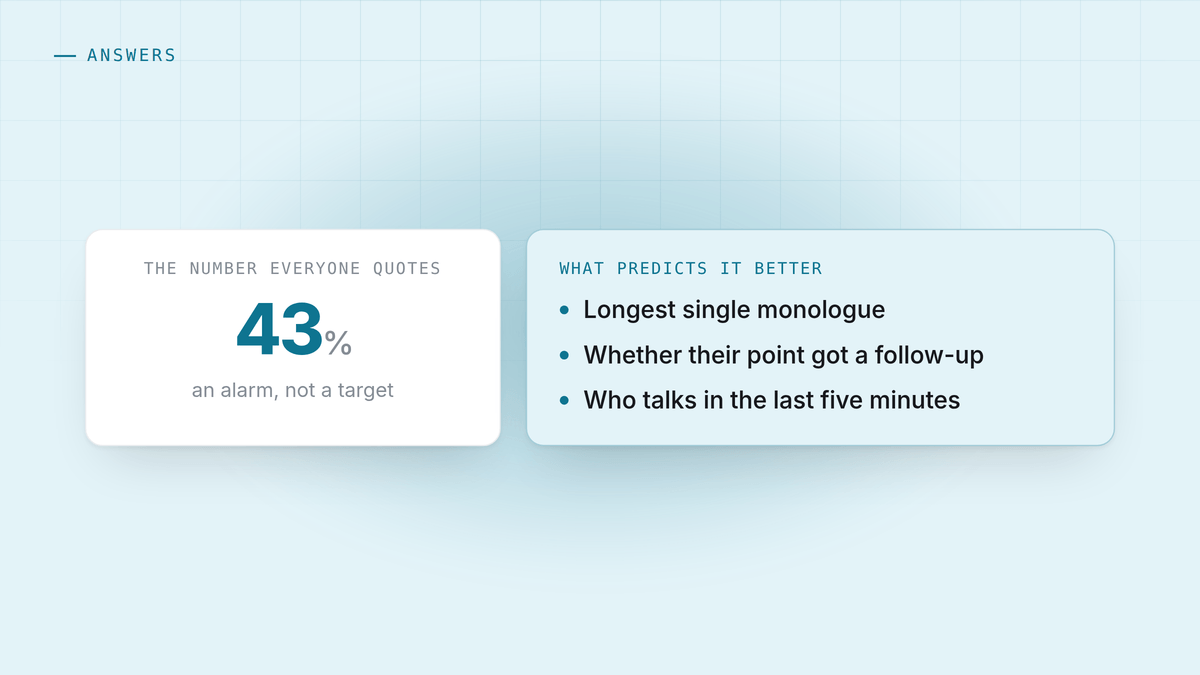
You will find a specific number quoted everywhere: talk 43 percent of the time, listen 57. It comes from conversation-intelligence vendors analysing large numbers of recorded calls, and it is repeated so often that it has taken on the character of a law.
It is a real finding from real data, and treating it as a target is a mistake. Here is why, and what to do with it instead.
What the finding actually says
The vendors that publish these numbers analyse calls from their own customers, correlate speaking time against outcomes, and report that on successful discovery calls the seller talks less than the buyer, usually somewhere in the 40 to 50 percent range.
Two limits worth holding onto.
It is correlation. Sellers who talk less are usually asking better questions, and buyers who talk more are usually more engaged. The ratio is a symptom of both. Talking less while asking the same weak questions produces silence, not a sale.
It is one kind of call. The number comes mostly from discovery. A technical deep dive where the buyer asked you to explain the architecture, a negotiation, a demo they requested: these have legitimately different shapes, and hitting 43 percent on a demo would mean not answering the questions you were asked.
The number is still useful
Not as a target, as an alarm.
If you are at 75 percent on a discovery call, something is wrong and you do not need a study to tell you. Almost always one of three things:
You are pitching instead of asking. The most common cause by a distance.
You are answering your own questions. “What is the main problem, is it the reporting side?” Stacked question plus offered answer, and they take the offered one.
You are filling silence. They pause for two seconds, you fill it, and the sentence they were assembling is lost. That sentence is regularly the most valuable thing in the call.
At 75 percent, all three are usually happening. That is worth knowing. Whether you should have been at 43 or 48 is not.
What to measure instead
Four things that predict the outcome better than a percentage.
Longest monologue. One uninterrupted four minute stretch is worse than a slightly high overall ratio spread evenly. Anything past about two minutes and you have stopped having a conversation.
Question count, and question quality. Twenty questions that could not have changed what you did next is not discovery. The questions that do change it are a short list.
Follow-up rate. When they say something important, does the next thing you say build on it, or move to your next topic? This is the single strongest signal of a good discovery call and nobody measures it.
Who talks in the last five minutes. If it is mostly you, the close is a pitch rather than a confirmation. That part has its own piece.
The ratio you cannot see while it is happening
The problem with all of this is that nobody can track their own talk ratio during a conversation. By the time you notice you have been going for four minutes, you have been going for four minutes.
That is a fair thing to hand to software. HuddleOwl tracks both sides separately, because the microphone and the system audio are separate tracks rather than one merged stream, so the ratio is a measurement rather than an estimate from speaker diarisation. When a monologue runs long, a card appears while you are still in it, which is the only point at which the information is worth anything.
Afterwards the brief reports the ratio, the longest stretch, and which of their statements never got a follow-up, with the transcript line behind each. That last one is the number worth watching. It changes calls more than the percentage does.
The short version
- 43 percent is a finding, not a rule. It comes from correlation on discovery calls.
- Use it as an alarm. 75 percent on discovery means you are pitching. 50 versus 45 means nothing.
- Different calls have different shapes, and a demo is allowed to be you talking.
- Longest monologue and follow-up rate tell you more than the ratio, and both are fixable in the moment.
HuddleOwl measures both sides of the call from separate tracks on your own machine, tells you during the call when a monologue is running long, and scores how you ran it afterwards. Free, and nothing joins the meeting.
References
- Gong: talk ratio research, one of the original sources for the number. Their data, their customers, worth reading with that in mind.
- We have not run our own study, and this post does not claim one.


