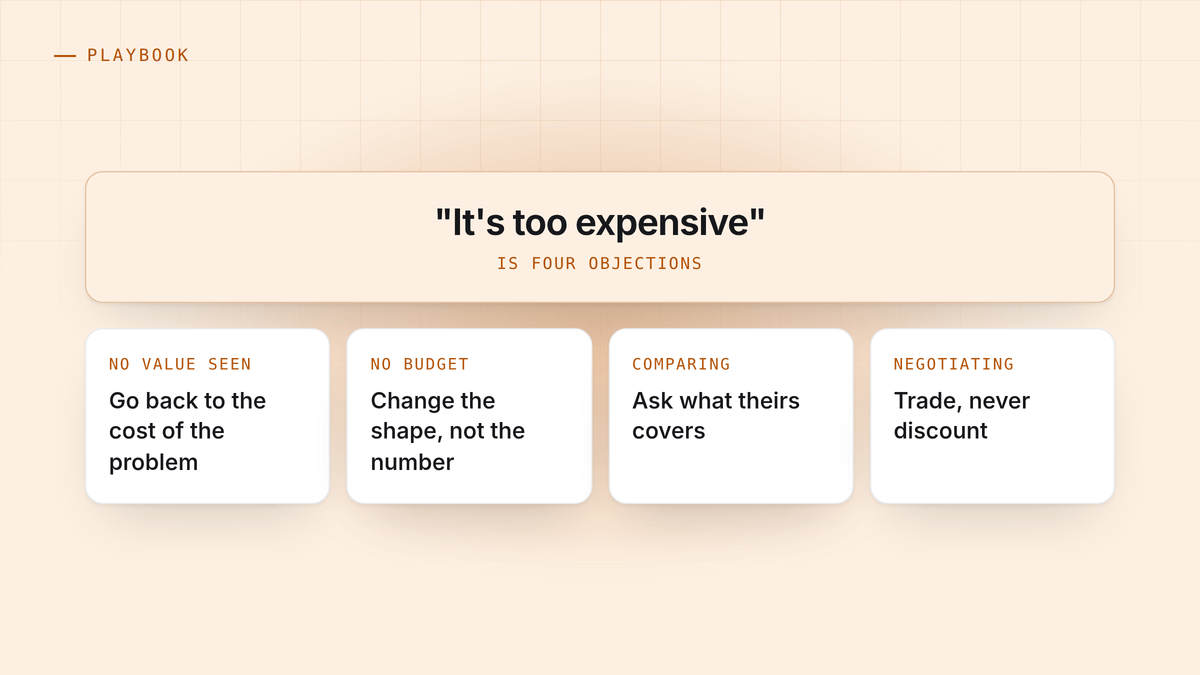
“It’s too expensive” is not one objection. It is four, and they need opposite responses, so the first move is never a response at all.
The four things it means
1. I do not see the value. The number is fine, the case for it is not. Your fault, and fixable.
2. I do not have the budget. The value is understood, the money genuinely is not there this quarter. Not fixable by talking, but the timing is now known.
3. I am comparing it to something cheaper. A competitor, or building it themselves, or doing nothing. This is a scope conversation, not a price one.
4. I am negotiating. They want a discount and this is the opening move. Discounting here teaches them the first number was never real.
Every one of these is said with the same five words. Responding to the wrong one is how a deal that was about scope turns into a deal about price.
The first move is always a question
Not a defence, not a justification, not a discount. One question, then silence.
“Can you say more about that?”
Or, more precisely:
“Expensive compared to what?”
That second one does most of the work, because the answer names the comparison. “Compared to what we pay now.” “Compared to the other quote.” “Compared to nothing, because we do this in a spreadsheet.” Each of those is a different deal.
Then stop talking. The instinct is to fill the pause with the value story, and that instinct is what turns a diagnosable objection into a guess.
What to say to each
They do not see the value
Go back to the cost of the problem, in their numbers.
“Earlier you said the approval chase costs about two weeks per project, and you run maybe forty a year. What does two weeks cost you?”
If you do not have that number, the discovery was incomplete, and the price objection is just where it became visible. That is a discovery problem, not a pricing one.
They do not have the budget
Believe them, and change the shape rather than the number.
“That is fair. Is it the total, or the timing? If we started with just the one team in January, would that sit inside what you have?”
Budget objections are frequently timing objections. Smaller scope now, or the same scope starting next quarter, keeps a real deal alive without teaching them your price is soft.
They are comparing it to something cheaper
Get the comparison onto the table and compare like for like.
“What does theirs cover on the migration side? That is the part that took you six months last time.”
Never disparage the competitor. Ask what their quote includes. Either it includes it, in which case you have learned something real, or it does not, and they discover the gap themselves, which is worth far more than you naming it.
They are negotiating
Hold the price, and trade instead of discounting.
“I can do that number for a two year term.” Or: “at that price it would be the two modules rather than the four.”
A discount given for nothing tells them two things: the first number was inflated, and pushing works. Both of those cost you the renewal, not just this deal.
The thing not to say
“It is an investment, not a cost.” Everybody has heard it, it answers nothing, and it signals that you have run out.
“What if I could get you ten percent off?” Offered before diagnosing, this converts a value conversation into a price one and you cannot convert it back.
A long justification of the price. Length reads as anxiety. If the value case needs four minutes at this point, it needed to be made earlier.
Where price objections actually get created
Most of them are made much earlier in the call, at the moment somebody moves to price before the cost of the problem has been established. Quote a number against a problem the buyer has not yet sized and it is compared against nothing, so it sounds like a lot.
This is specific and catchable: HuddleOwl watches for price being named before the cost of the problem was, and puts a card on screen while there is still time to go back. The card quotes the line that triggered it, so you can see in a glance whether it is right, and it cannot appear without that quote.
Afterwards, the brief shows which objections were surfaced and answered and which were talked past, with the transcript line behind each. Talked past is the common one, and it is almost never the one you remember.
HuddleOwl coaches you during the call and scores it afterwards, from your own machine, with nothing joining the meeting. Free. There is a page for sales.


