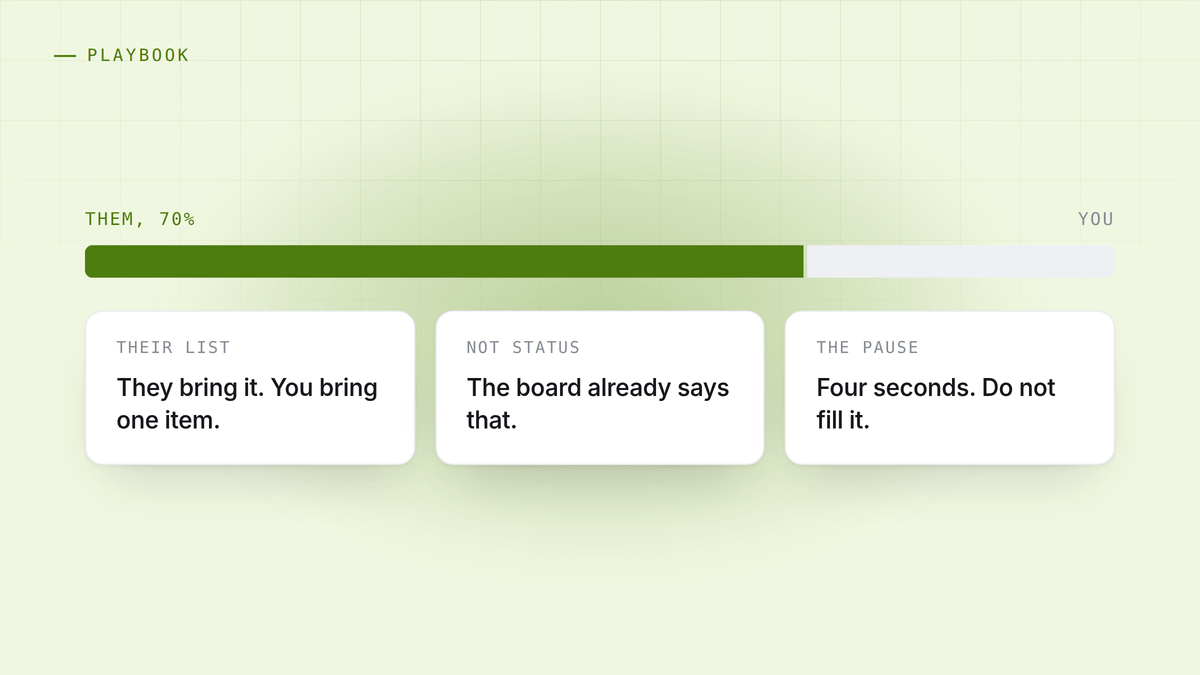
A one to one that reviews project status is a status meeting with two people in it. The board already has that information, both of you know it, and the half hour goes on something neither of you needed.
The failure is not laziness. It is that status is the easiest thing to talk about, and it reliably fills the time so neither person has to start the harder conversation.
What the meeting is for
Three things, none of which appear on a project board:
What is hard that nobody else can see. Blocked by a person, unclear on what success looks like, drowning, bored.
What they are working towards. Not this sprint. This year.
What you are getting wrong. They can see things about how you manage that you cannot, and they will only say them if the meeting has made room for it.
If none of the three came up, the meeting did not happen, whatever was said.
Their agenda, not yours
The single highest-leverage change: they bring the list, you bring one item.
A shared document they add to during the week, and you add to occasionally. They open the meeting. You get one thing, not six.
This inverts the default, where the manager arrives with an agenda and the report answers questions for thirty minutes. That version produces compliance, not information.
If they arrive with nothing, that is data. Ask why. Usually it is that previous one to ones taught them the meeting was for you.
Questions that get past status
Ask one, not five. The follow-ups are the actual conversation.
- “What is taking more of your energy than it should?” Better than “how are things”, which gets “fine”. Energy is a thing people can locate.
- “What would you do differently if it were entirely your call?” Surfaces disagreement that would otherwise stay unsaid.
- “What is the least useful thing you are doing?” Often something you asked for and forgot about.
- “Where are you unclear on what good looks like?” Almost always somewhere. Ambiguity about the standard is a common cause of stalling that looks like reluctance.
- “Is there anything you have been meaning to raise and have not?” Then be quiet. This is the question, and the silence after it is the mechanism.
- “What is one thing I should do differently?” Ask it every few months, not every week, and only if you can actually take the answer. Asking and then defending yourself is worse than not asking.
The silence
The most valuable moments in a one to one follow a pause of four or five seconds, which feels like thirty when you are the manager.
Most people fill it. Filling it teaches the other person that pauses are yours to close, and they stop trying to use them. Sit in it. It is uncomfortable exactly twice.
Four ways it goes wrong
You talk more than they do. In a one to one this is close to a definitive failure signal. Roughly seventy percent them is a reasonable target, and most managers are surprised by their real number.
You cancel it. Cancelling a one to one is a message about priority whatever you say in the reschedule. Move it rather than cancelling, and if it is genuinely always the thing that gets dropped, make it shorter and keep it.
Feedback only appears here. If the only place someone hears they are off track is a scheduled meeting eleven days from now, it arrived too late to be useful.
You take no notes and remember nothing. The thing they mentioned once, in passing, about wanting to move into a different kind of work, is exactly the thing that matters in six months. If you cannot recall it, they will conclude, correctly, that it did not register.
Notes without the laptop lid
The last one is the practical problem. Typing through a one to one is worse than not taking notes, because it turns a conversation into an interview.
This is the same problem as taking interview notes, and the same solution: if the record takes itself, your attention stays in the room. HuddleOwl runs on your own machine, which for a conversation about somebody’s career, their frustration with a colleague, or their thoughts about leaving, is not a preference. That audio has no business on a vendor’s server, and where recordings usually end up is the reason.
It will also tell you, afterwards, how much of the meeting you spent talking. That number is the fastest way to find out whether the one to one is theirs or yours.
HuddleOwl runs entirely on your laptop with nothing joining the call, so the conversations that should never leave the room do not. Free.


