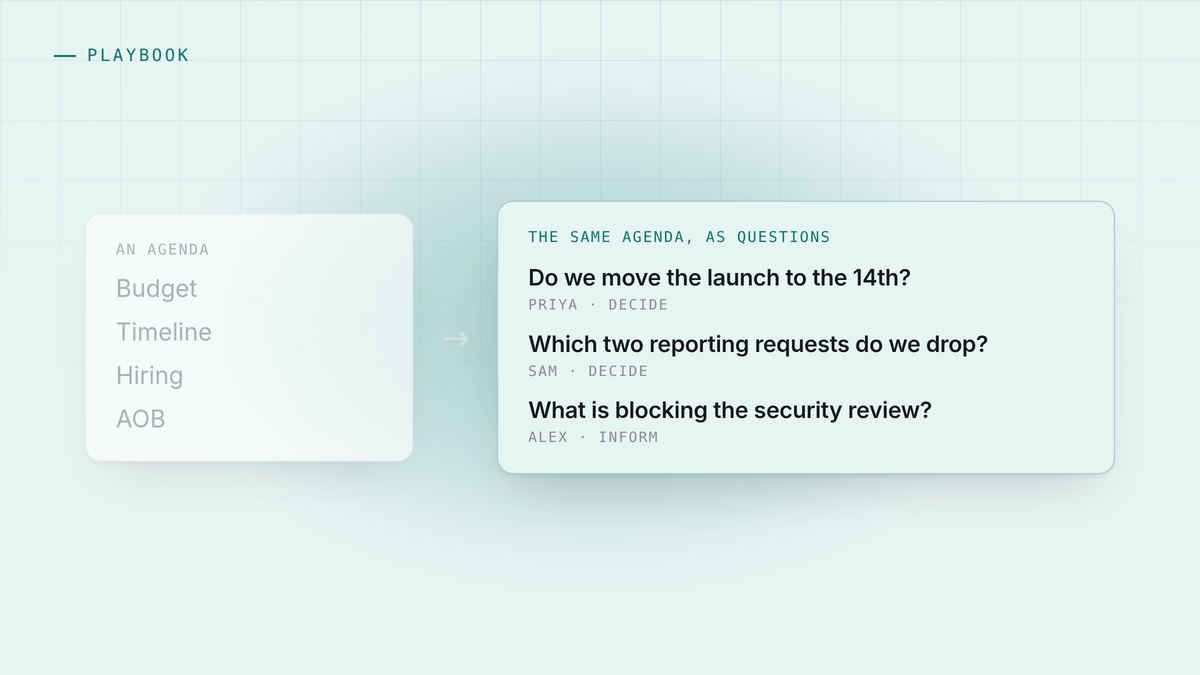
Nearly every agenda is a list of nouns.
- Budget
- Timeline
- Hiring
- AOB
Nobody can prepare for that, because nobody knows what is being asked. So everyone arrives cold, the first ten minutes are spent working out what the meeting is for, and the item that mattered gets four minutes at the end.
Write each item as a question
One change fixes most of it.
- Do we move the launch to the 14th, given the migration risk? (Priya, decide)
- Which two of the four reporting requests do we drop? (Sam, decide)
- What is blocking the security review? (Alex, inform)
Three things happen immediately.
People can prepare, because they know what they will be asked.
You can tell whether the meeting worked, because a question either got answered or it did not.
Items that are not questions become visible, and most of them turn out not to need a meeting.
Three fields per item
The question. Phrased so it can be answered yes, no, or with a name or a number.
The owner. The person who brought it and will run that section. Not the most senior person in the room by default.
The outcome type. Which of three things this item is for:
- Decide. Something is chosen. Requires the people who can choose to be present.
- Input. Somebody needs reactions before deciding later. Say so, or people will think they are deciding.
- Inform. One-way. These are the items that should usually have been a message.
Labelling the third one honestly is where most agendas get shorter. An agenda of six items where four are “inform” is a meeting that could have been a two-paragraph update and one fifteen minute call.
Put a time on each, and mean it
Not to be rigid, but because a time estimate is a claim about importance, and seeing it written down exposes the mismatch. An agenda that gives thirty minutes to the status update and ten to the decision has told you what will actually happen.
The rule that costs nothing: the most important item goes first. Not the quick one, not the warm-up. Meetings reliably run out of time and reliably run out of it at the end.
The four common shapes
A decision meeting. One question, the options already written down, the people who can decide in the room. Everything else is preparation and belongs in a document sent beforehand. If the options are not written down before the meeting, the meeting will be spent writing them.
A status meeting. The highest-risk thing first, not a round the table. Going in order of seating means the important risk is mentioned by the last person with three minutes left. A better prompt than “what did you do this week” is “what is most likely to slip, and what would stop it”.
A one to one. Their agenda, not yours. This shape deserves its own treatment and gets it in the 1:1 that is not a status update.
A client or external call. The agenda is a message sent the day before, in three lines, ending with “anything you want to add”. Sending it is a small act that changes the call: they arrive having thought about it, and their addition is usually the most valuable item on the list.
Send it before, not at the top
An agenda read out at the start is a formality. An agenda sent the day before is preparation. Same words, different function.
Two lines is enough:
Tomorrow, 30 mins. One question: do we move the launch to the 14th given the migration risk? Options and the risk write-up are in the doc. Anything you want to add?
What “any other business” is really doing
AOB is where the important thing goes when nobody wanted to put their name on it.
If something reliably appears under AOB, it is a real agenda item that somebody is uncomfortable raising formally. Move it up, give it an owner, and the discomfort usually turns out to be the point.
The meeting after the agenda
A good agenda gets you a meeting with a shape. It does not guarantee the shape survives contact: the decision item still drifts, the question still goes unanswered, and the call still ends with “let’s circle back” unless somebody notices in time.
Noticing in time while also running the conversation is the actual difficulty, and it is what HuddleOwl watches for: an agenda item with ten minutes left and no answer, a decision that was discussed and never made, a close approaching with no next step named. Afterwards it writes up what was decided, what was assigned and what is still open, which is the minutes problem solved from the same recording.
HuddleOwl runs on your own machine, nothing joins the call, and it tells you during the meeting when the thing you came for has not happened yet. Free.


